Kinesiology Glossary
Kinesiology Glossary
Hi, my name is Lauralys Panneton. I study in Social Sciences at Montmorency College. I am in this program in order to become a kinesiologist. I plan ongoing in kinesiology at the University of Quebec in Montreal. Scientifically, kinesiology is the study of the mechanics of the body's movements. A kinesiologist makes appointments with their clients to help them with personalized exercises, and treat or prevent injuries by doing active rehabilitation. Their goal is to improve the physical performance and the health of their clients. I created this glossary for people who would like to study kinesiology. My goal with this glossary is to help you if you get a blank on the meaning of a word or if, you are not sure about how to pronounce it. All twenty words in this glossary are kinesiology related terms.
- agonist (muscle)
- noun
- The muscle that contracts and provides the main force to create a specific movement at a joint, while its opposing muscle (the antagonist) relaxes to allow the action.
- Example: During a bicep curl, the biceps brachii acts as the agonist (prime mover), contracting to lift the weight while the triceps relaxes.
- fr: agoniste

- antagonist (muscle)
- noun
- The muscle that opposes the action of the agonist. Its role is to control, slow down, or stabilize movement.
- Example: During a bicep curl, the triceps act as the antagonist muscle, relaxing and lengthening to allow the biceps to contract and lift the weight.
- fr: antagoniste
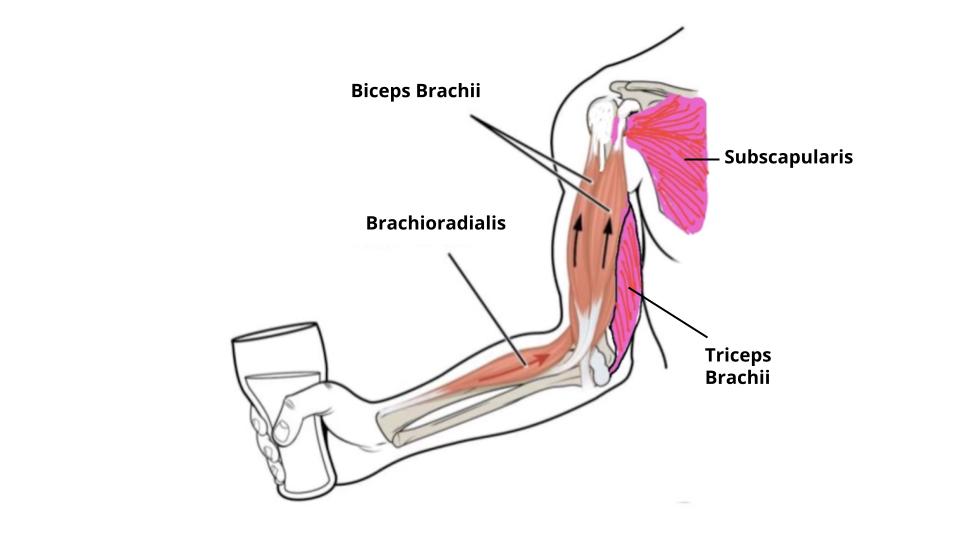
- synergist (muscle)
- noun
- A synergist muscle assists an agonist (a prime mover muscle) during an activity. It can produce force to support the movement and promote stability.
- Example: During a bicep curl, the brachialis acts as a synergist to the biceps brachii, helping to flex the elbow.
- fr: synergiste

- origin (attachment)
- noun
- The attachment site of a muscle to a bone that remains relatively fixed, stationary, or stable during muscular contraction.
- Example: The deltoid muscle's origin is located on the scapula and clavicle.
- fr: origine

- insertion (attachment)
- noun
- The insertion of a muscle is the structure that it attaches to and tends to be moved by the contraction of the muscle.
- Example: The biceps brachii muscle has its insertion on the radial tuberosity of the forearm, allowing for elbow flexion.
- fr: insertion

- uniarticulate (articulation)
- noun
- Having, or involving a single joint (or articulation).
- Example: The brachialis muscle provides a pure, uniarticulate contraction to flex the elbow joint.
- fr: uniarticulé
- biarticulate (articulation)
- noun
- Muscles or structures that span and move two distinct joints in the body.
- Example: The rectus femoris is a key biarticulate muscle that crosses both the hip and knee joints to facilitate powerful running motions.
- fr: biarticulé
- triarticulate (articulation)
- noun
- A structure that possesses or operates across three distinct joints or articulated segments.
- Example: The insect's triarticulate antennae allowed it to navigate the narrow crevice with ease, bending at each of the three distinct segments.
- fr: triarticulé
- flexion (movement)
- noun
- An anatomical movement that decreases the angle between two body parts or bones at a joint, commonly described as bending.
- Example: To properly target the biceps, ensure you reach full flexion at the elbow before slowly lowering the weight.
- fr: flexion

- extension (movement)
- noun
- An anatomical movement that increases the angle between two body parts or bones at a joint, typically straightening a limb or moving body parts posterior to the anatomical position.
- Example: The ballerina performed a graceful leg extension to the back.
- fr: extension
- eversion (movement)
- noun
- The anatomical movement of the sole of the foot away from the median plane (mid line) of the body, effectively tilting it outward.
- Example: During the soccer pivot, the athlete utilized strong eversion of the foot to change direction.
- fr: éversion
- abduction (movement)
- noun
- The anatomical action of moving a limb or body part away from the mid line of the body.
- Example: Perform three sets of standing hip abduction by lifting your leg out to the side.
- fr: abduction
- adduction (movement)
- noun
- An anatomical movement that pulls a limb or body structure toward the mid line of the body or the mid line of a limb.
- Example: The chest press exercise relies on shoulder adduction to bring the dumbbells together over the chest.
- fr: adduction
- rotation (movement)
- noun
- The circular movement of an object, body part, or rigid body around a central, fixed line known as an axis of rotation.
- Example: To improve your golf swing, focus on the rotation of your torso to generate power.
- fr: rotation
- isotonic (contraction)
- adjective
- A type of muscle contraction where the muscle changes length (shortens or lengthens) while maintaining constant tension.
- Example: Performing bicep curls is an example of an isotonic contraction, as the muscle changes length to move the weight.
- fr: isotonique
- isokinetic (contraction)
- adjective
- An isokinetic contraction is a type of muscle contraction where the muscle shortens or lengthens at a constant, controlled speed throughout the entire range of motion, regardless of the force applied.
- Example: To rehabilitate her knee, the therapist had her perform isokinetic squats at a controlled, steady speed using a specialized machine.
- fr: isocinétique
- concentric (contraction)
- adjective
- A concentric contraction is a type of muscle activation that causes tension on your muscle as it shortens.
- Example: During the upward phase of a biceps curl, the biceps undergo a concentric contraction to lift the dumbbell.
- fr: concentrique
- eccentric (contraction)
- adjective
- A type of muscle action where the muscle-tendon system lengthens while actively generating force.
- Example: Lower the dumbbell slowly during the bicep curl to maximize the eccentric phase.
- fr: excentrique
- dynamic (contraction)
- adjective
- An active movement where a muscle changes length—either shortening (concentric) or lengthening (eccentric)—against a resistance, resulting in joint movement.
- Example: The athlete focused on improving her contraction dynamics to increase explosive power.
- fr: dynamique
- isometric (contraction)
- adjective
- A type of muscle contraction where the muscle generates tension without changing length or causing joint movement.
- Example: Hold the plank position to maximize the isometric tension in your core.
- fr: isométrique


Comments
Post a Comment